History
How WITS started
The four WITS strategies were created by an unknown source on Vancouver Island. The first documented use was in 1993 at Lampson Street Elementary School in Esquimalt BC, where Principal Judi Stevenson had been teaching students its four simple conflict resolution strategies:
- Walk away, Ignore, Talk it out, and Seek help.
These WITS strategies were soon adopted by other local educators, and “using your WITS” quickly became a common phrase at schools in Greater Victoria.
After seeing the WITS strategies at work, Tom Woods, a school police liaison officer, sought to broaden its reach. In 1997, he launched the Rock Solid Foundation in collaboration with local athletes and law enforcement officials. Its mission: Provide violence prevention programs to children and youth.
Wanting to widen WITS’ impact as part of Rock Solid’s efforts, Woods, with Stevenson, local athletes and other collaborators evolved this simple set of WITS strategies and additional program elements into the first version of the WITS Program. Greater Victoria School District 61 (SD61) saw its potential and assigned teachers and counsellors to work with Rock Solid to review this new WITS Program. The second version of the WITS Program was developed in collaboration with SD61 and a research group at the University of Victoria. These collaborations enabled the evolution of the second version of the WITS Program, still based on literacy and now centered on a whole-community approach.
I found the WITS Program to be an exceptional tool to help children learn at an early age how to deal with peer victimization, and how important it is to treat each other with respect. Until bullying and peer victimization are a thing of the past, I strongly encourage other schools to implement the WITS program on an annual basis.
– Louie Scigliano, Principal, Glanford Middle School
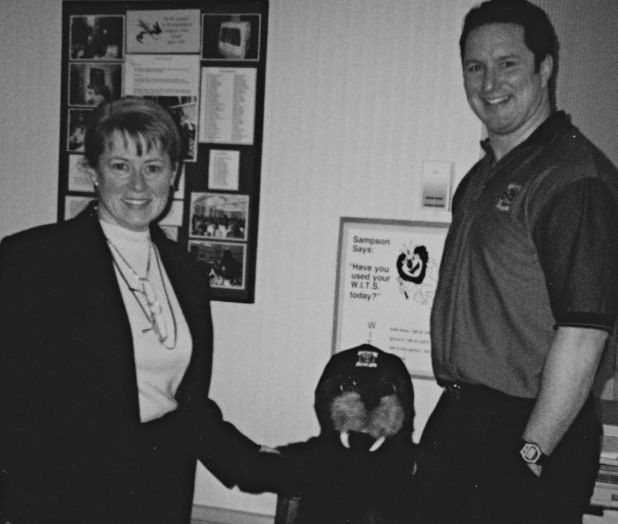
Judi Stevenson with Tom Woods in 1998. The original WITS strategies are behind mascot WITsup the walrus
The LEADS strategies
As the WITS Primary Program spread to Greater Victoria area schools, a question emerged. Where do older students fit in? If WITS was meant as a whole school approach to preventing peer victimization, students in Grades 4 to 6 would also need to be included.
The Rock Solid Foundation began collaborating with Frank Hobbs and Lake Hill Elementary Schools in Victoria to develop the WITS LEADS Program for students in Grades 4 to 6 (flexible based on the school).
The program reflects older children’s ability to understand other’s perspectives and recognizes them as leaders capable of making their schools and communities safer places for younger children. The LEADS acronym stands for a problem-solving approach to peer conflicts:
- Look and listen, Explore points of view, Act, Did it work?, and Seek help.
The LEADS strategies were piloted in 2005 in Victoria, BC and made widely available in 2006.
Across Canada
In 2011, WITS began working with the Royal Canadian Mounted Police to share the WITS message across the country, especially in rural areas.
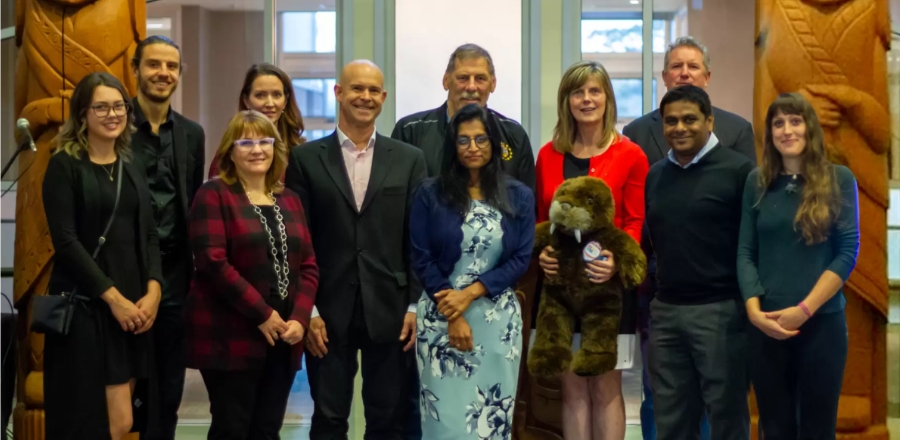
Foundation team in 2018 at the 20th Anniversary Celebration, held at the Songhees Wellness Centre.
The WITS Programs Foundation
Since then, the WITS Programs spread far and wide – across Canada, internationally to schools that used BC curiculla, and across the border to a few schools in the USA. In 2015, the university team wound up and moved all operations to the Rock Solid Foundation. With its only initiative being the WITS Program (WITS and LEADS), in 2016 the Rock Solid Foundation Society changed its name to WITS Programs Foundation Society (WITS Foundation). At this time WITS had been started in more than 1500 schools worldwide, earning endorsements from several authors and organizations. WITS was also the model for DIGA, a unique Portuguese version in Brazil.
New Programs and Upgrades
In 2020, program offerings expanded. Since 2021 the Foundation has produced Pink Shirt Day Canada, a nationally broadcast show delivering the Pink Shirt Day message to children and youth on Canada’s Pink Shirt Day every February. The programs Canadian Kindness Leaders and Pink Shirt Project, design to empower youth to respond positively to issues of concern in their lives; and the Focus Modules are educational packages on specific topics centred around inclusion.
In 2022 the Foundation introduced WITS 2.0, with six major changes: a new license/subscription feature, modernized visuals with accessibility, inclusion, and diversity in their designs, easier to follow implementation guidelines, increased emphasis on effective use of the program, simplified CORE and Classroom Module deployment system, and self-directed online educator & community leader training courses.
WITS 2.o and subsequent versions of the WITS Program help ensure more effective delivery, and Licenses/subscriptions help track of program use and provide value-added programming and other offers to WITS program users. Continuing with our literacy-based approach, the team of educators and program designers now up-to-date books, including those that align with modern Social-Emotional Learning themes in a new series called WITS Recommends.
WITS 3.o in 2026
In 2026 the Foundation upgraded WITS again as WITS 3.0. This latest version of the WITS Program includes revised visual designs, an extensive re-design and expansion of online resources including the WITS QUEST game, upgraded licence/subscription features, and use of AI to (ethically and confidentially) assist educators.
The Foundation is constantly developing new tools and programming and will continue to innovate, partner and have a positive impact on communities.